Military Time Chart
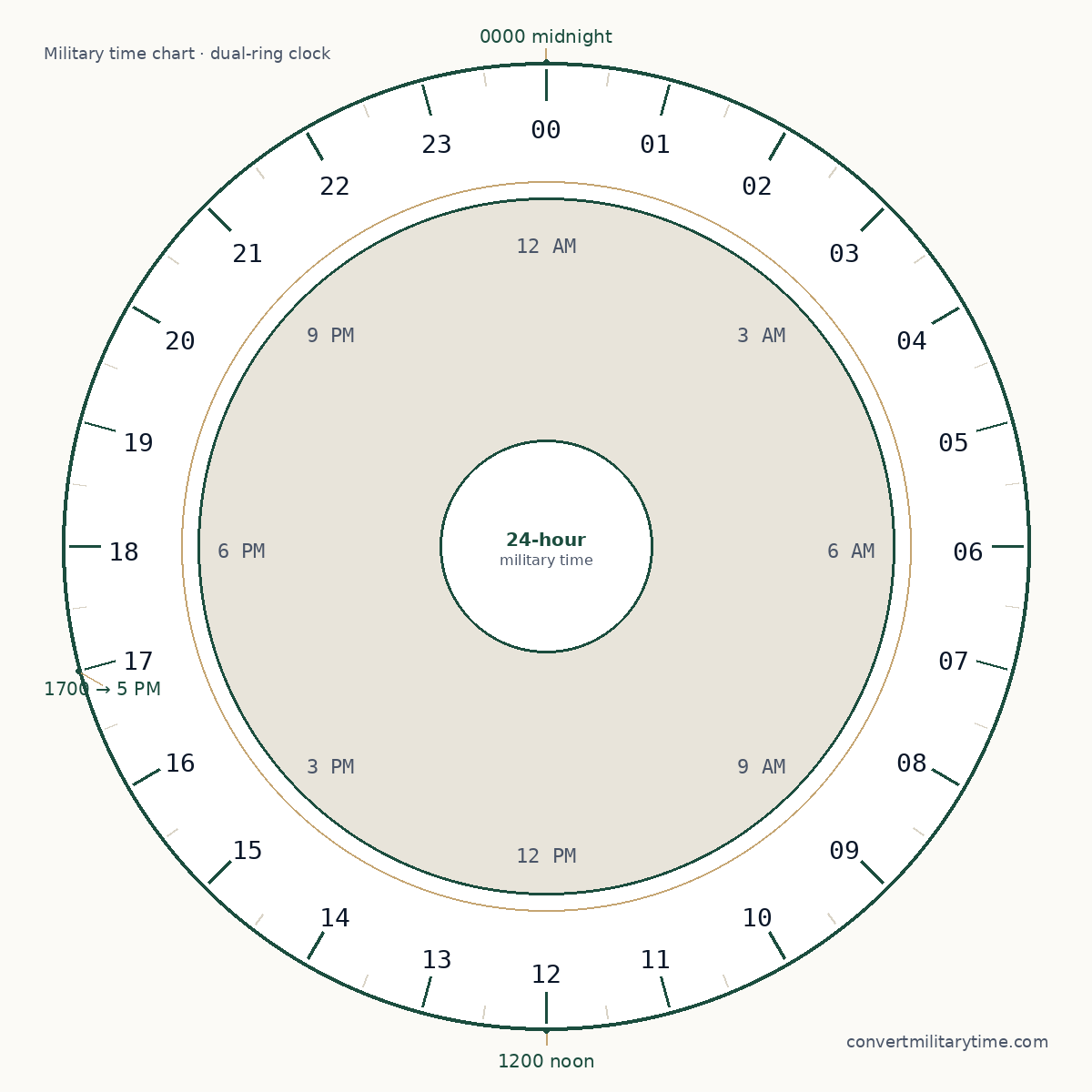
Every row is 15 minutes from 0000 to 2345. 0000 is 12:00 AM. 1200 is noon. 1700 is 5:00 PM. Download the printable PDF or print this page for a paper copy.
Open the converter · 24 hour clock · Count shift hours · Minute → decimal table
Jump to a time
| Military | With colon | Standard | Say it |
|---|---|---|---|
| 0000 | 00:00 | 12:00 AM | zero hundred |
| 0015 | 00:15 | 12:15 AM | zero fifteen |
| 0030 | 00:30 | 12:30 AM | zero thirty |
| 0045 | 00:45 | 12:45 AM | zero forty-five |
| 0100 | 01:00 | 1:00 AM | one hundred |
| 0115 | 01:15 | 1:15 AM | one fifteen |
| 0130 | 01:30 | 1:30 AM | one thirty |
| 0145 | 01:45 | 1:45 AM | one forty-five |
| 0200 | 02:00 | 2:00 AM | two hundred |
| 0215 | 02:15 | 2:15 AM | two fifteen |
| 0230 | 02:30 | 2:30 AM | two thirty |
| 0245 | 02:45 | 2:45 AM | two forty-five |
| 0300 | 03:00 | 3:00 AM | three hundred |
| 0315 | 03:15 | 3:15 AM | three fifteen |
| 0330 | 03:30 | 3:30 AM | three thirty |
| 0345 | 03:45 | 3:45 AM | three forty-five |
| 0400 | 04:00 | 4:00 AM | four hundred |
| 0415 | 04:15 | 4:15 AM | four fifteen |
| 0430 | 04:30 | 4:30 AM | four thirty |
| 0445 | 04:45 | 4:45 AM | four forty-five |
| 0500 | 05:00 | 5:00 AM | five hundred |
| 0515 | 05:15 | 5:15 AM | five fifteen |
| 0530 | 05:30 | 5:30 AM | five thirty |
| 0545 | 05:45 | 5:45 AM | five forty-five |
| 0600 | 06:00 | 6:00 AM | six hundred |
| 0615 | 06:15 | 6:15 AM | six fifteen |
| 0630 | 06:30 | 6:30 AM | six thirty |
| 0645 | 06:45 | 6:45 AM | six forty-five |
| 0700 | 07:00 | 7:00 AM | seven hundred |
| 0715 | 07:15 | 7:15 AM | seven fifteen |
| 0730 | 07:30 | 7:30 AM | seven thirty |
| 0745 | 07:45 | 7:45 AM | seven forty-five |
| 0800 | 08:00 | 8:00 AM | eight hundred |
| 0815 | 08:15 | 8:15 AM | eight fifteen |
| 0830 | 08:30 | 8:30 AM | eight thirty |
| 0845 | 08:45 | 8:45 AM | eight forty-five |
| 0900 | 09:00 | 9:00 AM | nine hundred |
| 0915 | 09:15 | 9:15 AM | nine fifteen |
| 0930 | 09:30 | 9:30 AM | nine thirty |
| 0945 | 09:45 | 9:45 AM | nine forty-five |
| 1000 | 10:00 | 10:00 AM | ten hundred |
| 1015 | 10:15 | 10:15 AM | ten fifteen |
| 1030 | 10:30 | 10:30 AM | ten thirty |
| 1045 | 10:45 | 10:45 AM | ten forty-five |
| 1100 | 11:00 | 11:00 AM | eleven hundred |
| 1115 | 11:15 | 11:15 AM | eleven fifteen |
| 1130 | 11:30 | 11:30 AM | eleven thirty |
| 1145 | 11:45 | 11:45 AM | eleven forty-five |
| 1200 | 12:00 | 12:00 PM | twelve hundred |
| 1215 | 12:15 | 12:15 PM | twelve fifteen |
| 1230 | 12:30 | 12:30 PM | twelve thirty |
| 1245 | 12:45 | 12:45 PM | twelve forty-five |
| 1300 | 13:00 | 1:00 PM | thirteen hundred |
| 1315 | 13:15 | 1:15 PM | thirteen fifteen |
| 1330 | 13:30 | 1:30 PM | thirteen thirty |
| 1345 | 13:45 | 1:45 PM | thirteen forty-five |
| 1400 | 14:00 | 2:00 PM | fourteen hundred |
| 1415 | 14:15 | 2:15 PM | fourteen fifteen |
| 1430 | 14:30 | 2:30 PM | fourteen thirty |
| 1445 | 14:45 | 2:45 PM | fourteen forty-five |
| 1500 | 15:00 | 3:00 PM | fifteen hundred |
| 1515 | 15:15 | 3:15 PM | fifteen fifteen |
| 1530 | 15:30 | 3:30 PM | fifteen thirty |
| 1545 | 15:45 | 3:45 PM | fifteen forty-five |
| 1600 | 16:00 | 4:00 PM | sixteen hundred |
| 1615 | 16:15 | 4:15 PM | sixteen fifteen |
| 1630 | 16:30 | 4:30 PM | sixteen thirty |
| 1645 | 16:45 | 4:45 PM | sixteen forty-five |
| 1700 | 17:00 | 5:00 PM | seventeen hundred |
| 1715 | 17:15 | 5:15 PM | seventeen fifteen |
| 1730 | 17:30 | 5:30 PM | seventeen thirty |
| 1745 | 17:45 | 5:45 PM | seventeen forty-five |
| 1800 | 18:00 | 6:00 PM | eighteen hundred |
| 1815 | 18:15 | 6:15 PM | eighteen fifteen |
| 1830 | 18:30 | 6:30 PM | eighteen thirty |
| 1845 | 18:45 | 6:45 PM | eighteen forty-five |
| 1900 | 19:00 | 7:00 PM | nineteen hundred |
| 1915 | 19:15 | 7:15 PM | nineteen fifteen |
| 1930 | 19:30 | 7:30 PM | nineteen thirty |
| 1945 | 19:45 | 7:45 PM | nineteen forty-five |
| 2000 | 20:00 | 8:00 PM | twenty hundred |
| 2015 | 20:15 | 8:15 PM | twenty fifteen |
| 2030 | 20:30 | 8:30 PM | twenty thirty |
| 2045 | 20:45 | 8:45 PM | twenty forty-five |
| 2100 | 21:00 | 9:00 PM | twenty-one hundred |
| 2115 | 21:15 | 9:15 PM | twenty-one fifteen |
| 2130 | 21:30 | 9:30 PM | twenty-one thirty |
| 2145 | 21:45 | 9:45 PM | twenty-one forty-five |
| 2200 | 22:00 | 10:00 PM | twenty-two hundred |
| 2215 | 22:15 | 10:15 PM | twenty-two fifteen |
| 2230 | 22:30 | 10:30 PM | twenty-two thirty |
| 2245 | 22:45 | 10:45 PM | twenty-two forty-five |
| 2300 | 23:00 | 11:00 PM | twenty-three hundred |
| 2315 | 23:15 | 11:15 PM | twenty-three fifteen |
| 2330 | 23:30 | 11:30 PM | twenty-three thirty |
| 2345 | 23:45 | 11:45 PM | twenty-three forty-five |
Minutes within the hour
The last two digits of military time are minutes. Any whole hour shares the same :00–:59 map to a 12-hour reading and a payroll decimal fraction of an hour. Formula: decimal hours = HH + MM/60 (24-hour wall-clock hour plus minutes ÷ 60), rounded to hundredths — confirm with your payroll system.
Worked examples
- 1705 → 5:05 PM · decimal 17.08 (5 ÷ 60)
- 1820 → 6:20 PM · decimal 18.33 (20 ÷ 60)
- 1735 → 5:35 PM · decimal 17.58 (35 ÷ 60)
:05 → 5 minutes past · +0.08 hour
| Minute (MM) | 12-hour fragment | Decimal hour (MM÷60) |
|---|---|---|
| 00 | :00 — on the hour | 0.00 |
| 01 | :01 — 1 minute past | 0.02 |
| 02 | :02 — 2 minutes past | 0.03 |
| 03 | :03 — 3 minutes past | 0.05 |
| 04 | :04 — 4 minutes past | 0.07 |
| 05 | :05 — 5 minutes past | 0.08 |
| 06 | :06 — 6 minutes past | 0.10 |
| 07 | :07 — 7 minutes past | 0.12 |
| 08 | :08 — 8 minutes past | 0.13 |
| 09 | :09 — 9 minutes past | 0.15 |
| 10 | :10 — 10 minutes past | 0.17 |
| 11 | :11 — 11 minutes past | 0.18 |
| 12 | :12 — 12 minutes past | 0.20 |
| 13 | :13 — 13 minutes past | 0.22 |
| 14 | :14 — 14 minutes past | 0.23 |
| 15 | :15 — 15 minutes past (quarter past) | 0.25 |
| 16 | :16 — 16 minutes past | 0.27 |
| 17 | :17 — 17 minutes past | 0.28 |
| 18 | :18 — 18 minutes past | 0.30 |
| 19 | :19 — 19 minutes past | 0.32 |
| 20 | :20 — 20 minutes past | 0.33 |
| 21 | :21 — 21 minutes past | 0.35 |
| 22 | :22 — 22 minutes past | 0.37 |
| 23 | :23 — 23 minutes past | 0.38 |
| 24 | :24 — 24 minutes past | 0.40 |
| 25 | :25 — 25 minutes past | 0.42 |
| 26 | :26 — 26 minutes past | 0.43 |
| 27 | :27 — 27 minutes past | 0.45 |
| 28 | :28 — 28 minutes past | 0.47 |
| 29 | :29 — 29 minutes past | 0.48 |
| 30 | :30 — 30 minutes past (half past) | 0.50 |
| 31 | :31 — 31 minutes past | 0.52 |
| 32 | :32 — 32 minutes past | 0.53 |
| 33 | :33 — 33 minutes past | 0.55 |
| 34 | :34 — 34 minutes past | 0.57 |
| 35 | :35 — 35 minutes past | 0.58 |
| 36 | :36 — 36 minutes past | 0.60 |
| 37 | :37 — 37 minutes past | 0.62 |
| 38 | :38 — 38 minutes past | 0.63 |
| 39 | :39 — 39 minutes past | 0.65 |
| 40 | :40 — 40 minutes past | 0.67 |
| 41 | :41 — 41 minutes past | 0.68 |
| 42 | :42 — 42 minutes past | 0.70 |
| 43 | :43 — 43 minutes past | 0.72 |
| 44 | :44 — 44 minutes past | 0.73 |
| 45 | :45 — 45 minutes past (quarter to) | 0.75 |
| 46 | :46 — 46 minutes past | 0.77 |
| 47 | :47 — 47 minutes past | 0.78 |
| 48 | :48 — 48 minutes past | 0.80 |
| 49 | :49 — 49 minutes past | 0.82 |
| 50 | :50 — 50 minutes past | 0.83 |
| 51 | :51 — 51 minutes past | 0.85 |
| 52 | :52 — 52 minutes past | 0.87 |
| 53 | :53 — 53 minutes past | 0.88 |
| 54 | :54 — 54 minutes past | 0.90 |
| 55 | :55 — 55 minutes past | 0.92 |
| 56 | :56 — 56 minutes past | 0.93 |
| 57 | :57 — 57 minutes past | 0.95 |
| 58 | :58 — 58 minutes past | 0.97 |
| 59 | :59 — 59 minutes past | 0.98 |
Rounded to hundredths for common US timesheet import. Your employer’s system may round differently.
Military time for payroll
Decimal hours are a bookkeeping format for US timesheets and payroll imports — not another time zone. Use them when a form asks for hours as a number (for example 17.50 instead of 5:30 PM).
| Military | Clock | Decimal hours (HH + MM/60) |
|---|---|---|
| 1700 | 5:00 PM | 17.00 |
| 1730 | 5:30 PM | 17.50 |
| 1800 | 6:00 PM | 18.00 |
| 1705 | 5:05 PM | 17.08 |
| 1820 | 6:20 PM | 18.33 |
Rounding follows your employer’s rules; these figures are convenience conversions. To measure the length of a shift between two punches, use the military time hours calculator.
How to read a row
Each row lists the four-digit military time, the same time with a colon, the 12-hour reading, and a short way to say it. 1700 and 17:00 are the same clock time: 5:00 PM, said seventeen hundred. Follow the Military column when a form wants digits only.
Common mistakes
2400 vs 0000: Both sit on midnight. 0000 opens a day; many duty rosters write 2400 when a task ends at the close of the listed date. This chart starts at 0000 and does not print a 2400 row.
Noon vs midnight: 1200 is 12:00 PM (noon). 0000 is 12:00 AM (midnight start). Mixing those two is the most common civilian error on 24-hour boards.
Leading zeros: Morning hours keep the zero — 0900, not 900 — so scanners and four-digit fields stay aligned.
The 15-minute grid above steps every 15 minutes. For other minutes (for example 1705 or 1820), use Minutes within the hour on this page. For payroll decimals, see the examples in Military time for payroll, or open the hours calculator. The home converter still handles any custom pair. A full 00–59 minute → decimal table also sits on the converter home.
When to use this chart
Use the converter on the home page when you have one odd time to translate. Stay on this chart when you need to scan a block of the day, brief a room, or print a wall reference.
- 15-minute grid above — quick reading for briefings and printable PDFs. Jump links cover the evening hours people look up most.
- Minutes within the hour — any :00–:59 against 12-hour wording and payroll decimals, without building a 1,440-row table.
- Payroll examples — worked military punches with decimal hours, plus a path into the hours calculator for shift length.
- Clock-face PNG — a dual-ring image you can reuse with attribution when a slide deck needs a visual, not another spreadsheet.
Hospitals post charts at nurse stations so night staff can confirm a med time without unlocking a phone. Flight ops and warehouse desks keep a paper copy beside the radio. Teachers use the evening deep links when a syllabus suddenly says “report at 1700.”
12-hour vs 24-hour on real schedules
Both formats describe the same day. The choice is about who reads the board and how expensive a misread is.
- Visitor-facing calendars often keep 5:00 PM because parents and patients already think in AM/PM.
- Staff boards, MAR charts, and watch bills lean on 1700 so “7” cannot slide between morning labs and evening meds.
- Mixed audiences should print both once in the header — “1700 / 5:00 PM” — instead of hoping everyone remembers the conversion under pressure.
- Cross-timezone invites still need a zone label. Writing 1700 does not make the meeting Eastern, Pacific, or Zulu; add EST, PT, or Z when the room is not standing under the same clock.
If you only need one pair converted, the home converter is faster. If you need the shape of the afternoon — where 1500, 1600, and 1700 sit relative to each other — this chart is the better tool.
Popular evening hours
Deep links for high-traffic lookups: 1700, 1730, 1800, 1900, 2000, 2100, 2200, 2300, plus afternoon 1300, 1400, 1500, and 1600.
Chart questions
How do I read a military time chart row?
Each row pairs a four-digit military time with standard time. 1700 and 17:00 are both 5:00 PM. Say seventeen hundred.
Is 2400 the same as 0000 on the chart?
Both are midnight on the clock face. 0000 starts a day; schedules often write 2400 for the end of a day. This 15-minute chart begins at 0000.
Why does the chart skip some minutes?
This chart steps every 15 minutes so the grid stays readable and printable. For other minutes such as 1705 or 1820, use Minutes within the hour on this page (for example 1705 is 5:05 PM and 17.08 decimal hours). The home converter still handles any custom pair.
Where is the printable military time chart PDF?
Download military-time-chart-printable.pdf from this page for a clean paper copy of the 15-minute grid. A shareable dual-ring clock PNG is also on this page for reuse with attribution.
Do I need leading zeros on the chart?
Yes. Morning hours show as 0900, not 900, so four-digit forms stay consistent.
What is noon and midnight on the chart?
1200 is noon (12:00 PM). 0000 is midnight at the start of the day (12:00 AM).
Should I post a chart or just bookmark the converter?
Post a chart where people share one wall clock — nurse stations, ready rooms, warehouse desks. Bookmark the converter for one-off lookups on a phone. Many teams do both: paper for the room, converter for odd minutes such as 1705.
Why show both 12-hour and military columns?
Readers arrive from both habits. A dual column lets a civilian visitor and a night-shift nurse agree on the same row without arguing about AM and PM. The spoken column catches radio phrasing before someone says “seventeen o’clock.”